Palden Pema Ödling Three-year Retreat Center


Palden Pema Ödling Three-Year Retreat Center at Long-nying Chöling Monastery has long been a sanctuary for Dharma practitioners. Blessed by centuries of spiritual practice, its secluded location—far from the distractions of everyday life and surrounded by clean drinking water, lush forests, fresh mountain air, and inspiring scenic views—makes it an ideal environment for meditation, contemplation, and inner transformation.
Historically, this sacred area has been associated with Dharma practice since at least the time of Prince Tsangma in the 9th century. Over the generations, many yogis and practitioners have lived and practiced in this region, moving from hermitage to hermitage in the traditional style of renunciation. The founding yogi of Long-nying Chöling Monastery, together with many other practitioners, followed this life of simplicity, retreat, and deep meditative practice.
During the tenure of the Second Abbot, Yogi Lama Phuntsok Dorji, a predecessor of Khenrinpoche Namchak Dorji, the Dzogchen practice lineage especially flourished. Practitioners engaged in rigorous solitary retreats in simple bamboo huts on Blongla Mountain. Later, some practitioners moved to a location below the mountain, where they continued a complete range of Vajrayāna practices—from the preliminary practices of Ngöndro to the profound practices of the Great Perfection, Dzogchen. However, after Yogi Lama Phuntsok Dorji relocated to another secluded place, the retreat site gradually became deserted as disciples passed away or moved elsewhere.
In the 1970s and 1980s, the Fifth Abbot, Lama Norbu Wangdi, together with Lama Dolma Wangdi, completed a traditional three-year retreat in the same bamboo huts. During that time, Lama Neljorpa, a great yogi of Mahāmudrā and Dzogchen, visited and blessed the site, offering spiritual guidance and instruction to the retreatants. Although the blessings and practice lineage remained strong, the continuation of formal three-year retreats became difficult because of the lack of proper facilities. The bamboo huts were not durable against rain, wind, cold, and other natural conditions. There was no electricity until 2006, and no motorable road access until 2015. Even today, the nearest town is about a two-hour drive away on a rough farm road.
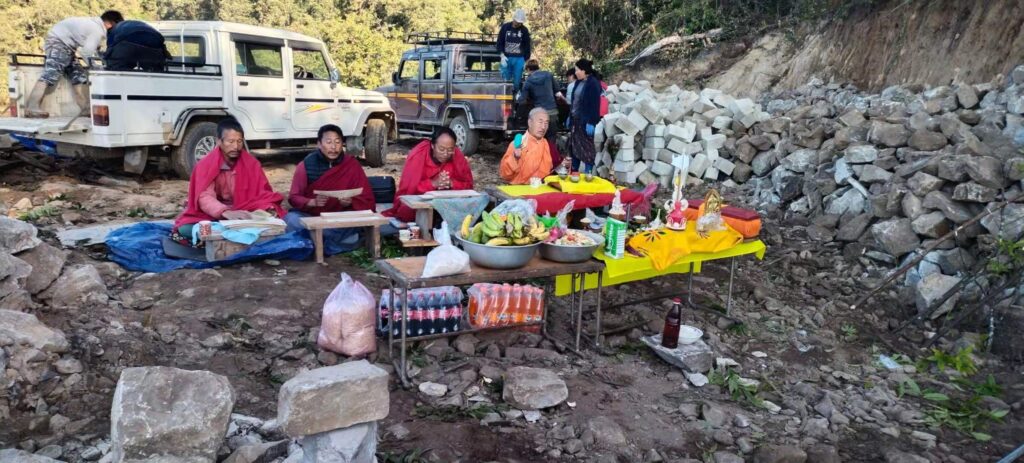
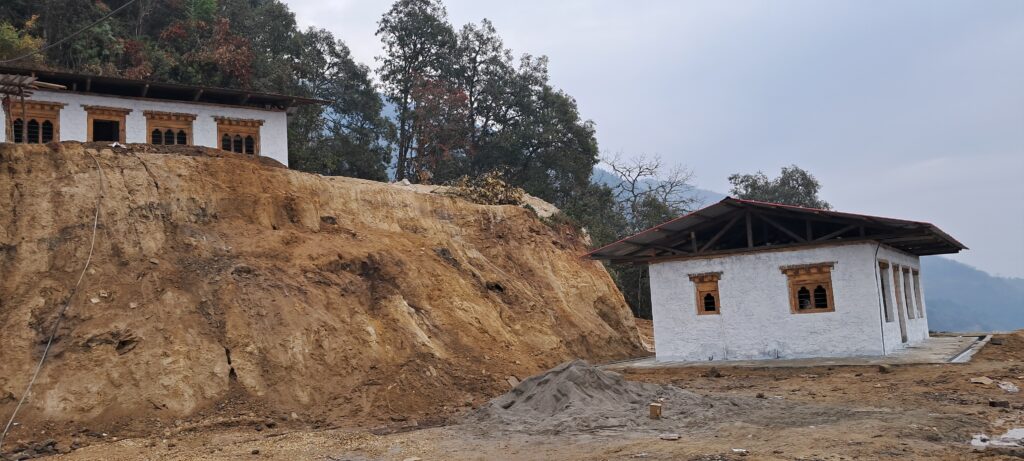
Over the years, many practitioners continued to undertake retreats of several months or even several years. However, the absence of permanent and reliable retreat facilities made it difficult for practitioners to enter and complete the traditional three-year, three-month, and three-day retreat in a sustained way. Recognizing this important need, Khenrinpoche Namchak Dorji, together with the monastic community, envisioned the reestablishment of a proper retreat center with sixteen permanent retreat cabins and a separate temple for common teachings, empowerments, transmissions, instructions, and group practice.
Under the supervision of Khenrinpoche Namchak Dorji, five retreat cabins have now been completed with the necessary facilities to support long-term retreat. Due to budget constraints, however, the remaining cabins and the retreat temple are still awaiting completion.
At the beginning of 2023, a formal three-year retreat program was successfully inaugurated. The retreat center was named Palden Pema Ödling, after the retreat center of the Omniscient Jigme Lingpa in Tibet. At present, eight dedicated practitioners are fully immersed in the profound spiritual practices of the Longchen Nyingtik lineage of the Nyingma school of Tibetan Buddhism, while being supported by improved facilities and a stable retreat environment.
A traditional three-year retreat is among the most intensive forms of Vajrayāna Buddhist practice. It requires years of prior training, strong discipline, sincere devotion, and the permission and guidance of qualified lineage teachers. During this period, practitioners live in seclusion and dedicate themselves entirely to meditation, recitation, contemplation, and the complete path of inner transformation.
During the three-year retreat, practitioners follow a systematic and progressive curriculum of the Longchen Nyingtik lineage.
In the first year, retreatants mainly focus on the Ngöndro, or preliminary practices. This includes the common outer preliminaries, which train the mind through contemplation on the precious human life, impermanence, karma, the suffering of saṃsāra, renunciation, faith, compassion, and bodhicitta. They also complete the uncommon inner preliminaries, traditionally known as the Five Hundred Thousand Ngöndro, in which five foundational practices are each accumulated 100,000 times: Taking Refuge, Generating Bodhicitta—the Heart of the Awakened Mind, Vajrasattva Purification, the Trikāya Maṇḍala Offering, and Guru Yoga. Through these practices, retreatants purify negative karma and obscurations, gather the accumulations of merit and wisdom, deepen devotion to the guru and lineage, and prepare the mind for the higher Vajrayāna practices.
In the second year, retreatants engage in various deity yoga practices of the generation stage, especially the practices of the Three Roots—the Guru, Yidam, and Ḍākinī. These practices are connected with the Mahāyoga tradition and train practitioners to purify ordinary perception, recognize appearances as sacred, and cultivate the enlightened mandala of awakened body, speech, and mind.
In the third year, retreatants enter the profound practices of Anuyoga and Atiyoga. The Anuyoga practices include completion stage methods such as tsa-lung, tummo, and trulkhor, working with the subtle body, channels, winds, and essences. The Atiyoga, or Dzogchen, practices include Rushen, Trekchö, and Tögal, which directly reveal the nature of mind and guide practitioners toward the realization of primordial purity and spontaneous presence.
Each day, the retreatants maintain a strict and disciplined schedule of four formal practice sessions, with each session lasting approximately three hours. Between these four sessions, they also perform daily auxiliary practices and offering rituals, including Sang, Tārā practice, Chutor or water torma offering, White and Red Sur offerings, Dharmapāla practices, and Chö. In this way, their daily schedule becomes a complete rhythm of meditation, recitation, offering, purification, protection, and dedication.
Throughout the retreat, practitioners receive the necessary empowerments, oral transmissions, teachings, and direct instructions from qualified lineage teachers. In this way, the retreat is not merely a period of isolation, but a living continuation of authentic Vajrayāna transmission and practice.
After the present retreatants complete their retreat, a new group of three-year retreatants will enter and continue the lineage of practice. The monastic foundation will continue to provide the necessary facilities, food, guidance, and support. As additional retreat cabins are completed, the center will be able to welcome both monastic and lay practitioners for long-term and short-term retreats. New retreatants are planned to enter every four years, while those who complete the retreat may remain for further practice if they wish.
The reestablishment of Palden Pema Ödling Three-Year Retreat Center represents a vital continuation of Bhutan’s sacred Vajrayāna heritage and the authentic practice lineage of the Longchen Nyingtik. Through this retreat center, the profound path of liberation is preserved, practiced, and transmitted for future generations.
May the tradition of authentic Vajrayāna practice flourish throughout the world, and may it bring immeasurable benefit to countless beings.